Finance
Why the Coinbase Commerce shutdown proves you need non-custodial payments
QBitFlow Team
4 min read
On this page · 6 sections
On March 31, 2026, Coinbase Commerce shuts down for good. Thousands of merchants, from indie SaaS founders to established e-commerce stores, are scrambling to find alternatives.
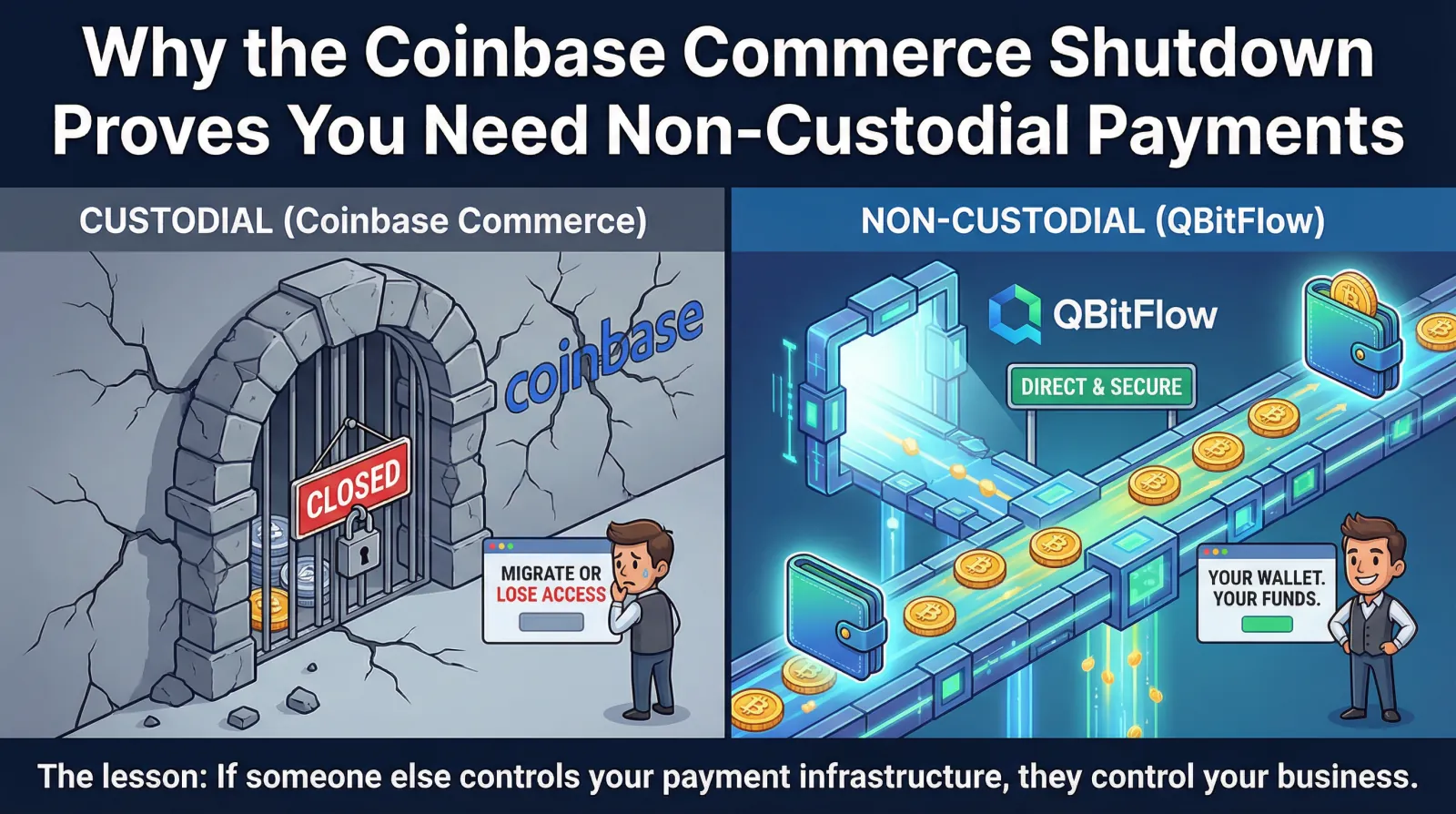
But the real lesson isn't "find another payment processor." It's this: if someone else controls your payment infrastructure, they control your business.
What happened
Coinbase launched Commerce in 2018 as a way for merchants to accept crypto payments. It worked. Merchants integrated it, built checkout flows around it, and processed real revenue through it.
Then Coinbase decided it wasn't worth maintaining. One email. Roughly 30 days notice. Migrate or lose access.
The replacement, Coinbase Business, is a different product entirely:
- Custodial (Coinbase holds your funds)
- US and Singapore only (international merchants are out of luck)
- Requires seed phrase management (the exact thing merchants wanted to avoid)
- No subscription support (Commerce never had it either, but still)
For merchants outside the US, there is no migration path. Coinbase just... stopped serving them.
The custodial trap
This isn't unique to Coinbase. It's the fundamental flaw of custodial payment processing, whether crypto or fiat.
When you use a custodial processor, you're renting access to your own revenue. The company sits between your customer's money and your wallet. They can:
- Change terms unilaterally (Stripe does this regularly)
- Freeze your funds (PayPal is notorious for this)
- Shut down entirely (hello, Coinbase Commerce)
- Restrict your industry (try accepting payments for CBD, adult content, or supplements through Stripe)
You don't own your payment rail. You're borrowing someone else's.
Non-custodial: the alternative that never holds your money
Non-custodial crypto payments work differently. There's no middleman holding funds. The money moves directly from your customer's wallet to yours, enforced by smart contracts on the blockchain.
Here's what that means in practice:
No one can freeze your funds. The payment goes to your wallet. Not a company's wallet. Not an escrow account. Yours.
No balance to lose if a processor goes away. Every payment is already in your wallet once its transaction confirms. There's no account balance waiting on a payout, so a shutdown can't take what you've been paid.
No seed phrase exposure. You provide a public wallet address. That's it. No private keys, no seed phrases, no custody risk.
Open-source and verifiable on-chain. The smart contracts are public. You can read exactly what they do. No black box.
How QBitFlow does it
We built QBitFlow around this principle from day one:
- Direct wallet-to-wallet payments via open-source smart contracts
- Ethereum, Base and Solana, with stablecoins like USDC and USDT, plus ETH and SOL
- Subscriptions: a spending cap model where your customers sign one allowance and are billed on each due date. Coinbase Commerce never had this.
- 0.99%, down to 0.5% with volume: no setup fees, no monthly fees, no withdrawal fees. The network fee is separate, paid by your customer.
- A WooCommerce plugin for WordPress stores
- TypeScript, Python, Go and PHP SDKs for custom integrations
- Hosted checkout: your customers go to a checkout page with your branding, then back to your site
You never need to manage private keys, handle custody, or trust a third party with your funds.
Migrating from Coinbase Commerce
If you're one of the merchants affected by the shutdown, here's the practical path:
- Sign up at qbitflow.app (takes 2 minutes)
- Connect your wallet: add your public address for each chain you accept, and sign a message to prove it's yours
- Swap the integration: replace Coinbase Commerce API calls with QBitFlow SDK calls. The flow is similar: create a checkout session, send your customer to its link, handle webhooks.
- Test in test mode before going live
If your store runs on WooCommerce, the plugin handles the checkout, with no code needed. Get started →
The bigger picture
The Coinbase Commerce shutdown is a symptom, not the disease. The disease is dependency on platforms that can change the rules whenever they want.
Non-custodial payments aren't just a crypto ideology thing. They're a practical business decision: your revenue should flow to your wallet, not through someone else's infrastructure that can disappear with 30 days notice.
Your wallet. Your funds. Your business.