
Crypto Accounting for Merchants: How to Get Tax-Ready Books Out of On-Chain Payments
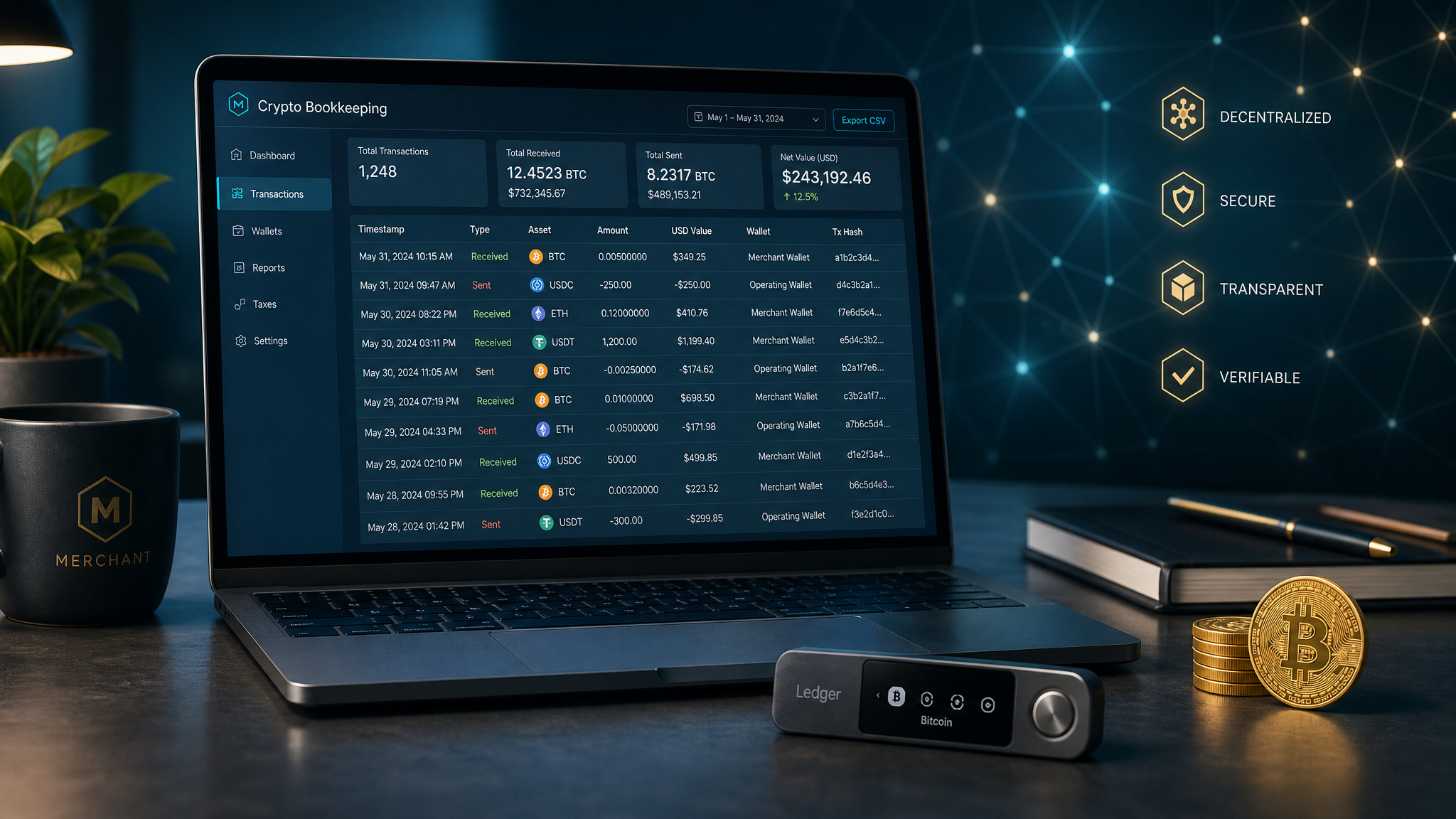
"How do I handle the accounting?" is the question that stops most merchants from accepting crypto. It's a fair one. Card processors hand you a clean monthly statement; a raw blockchain hands you a pile of hashes. If you can't get tax-ready books out of it, the lower fees don't matter.
Here's what crypto accounting actually requires, and what a proper export should give you so your accountant doesn't hate you.
Why raw blockchain data isn't enough
A block explorer shows you that 500 USDC moved from one address to another at a certain time. It does not tell you: what that was worth in USD at the moment you received it, which product it was for, which customer, what your processor's fee was, or whether it was a payment or a refund. Reconstructing all of that by hand — looking up historical exchange rates per transaction — is the painful part everyone warns you about.
That's the problem an accounting-grade export solves.
The one field that matters most: USD value at receipt
Under most tax regimes (the US IRS treats crypto as property valued at fair market value on the date of receipt), the number your accountant needs is the USD value at the moment you received each payment. Capture that at receipt and income recognition is correct out of the box. Miss it, and you're rebuilding historical prices months later.
A good export records USD-at-receipt on every single transaction, so you never reconstruct a rate.
What a tax-ready export actually contains
QBitFlow's one-click CSV export runs to 28 columns — everything an accountant needs, per transaction:
- Identity & type: payment ID, transaction type (payment / refund / subscription billing / fee split), UTC timestamp, related payment ID (so refunds and subscription billings link back to the original).
- What was sold: product ID, product name, description, customer UUID.
- On-chain proof: chain (Ethereum / Solana / Base), block number or slot, transaction hash, from/to address, and a direct explorer link per row.
- The money: token symbol, gross amount, gross amount in USD at receipt, platform fee (our 1.5%) in token and USD, organization/marketplace fee columns when applicable, network fees, and net amount.
It drops straight into QuickBooks, Xero, or whatever your bookkeeper already uses. Marketplaces get the fee-split columns broken out, so you can reconcile your cut against a vendor's from one file.
The honest part
This is the piece most crypto processors skip — they expose transaction history, but not in an accountant-ready format with USD-at-receipt and a per-transaction fee breakdown. It's unglamorous. It's also the difference between "we accept crypto" and "we accept crypto and our books close cleanly every quarter."
The rest of the picture
The accounting is clean because the payment model is clean: money moves directly from your customer's wallet to yours, non-custodial, in the exact token they paid — no conversion, no slippage, nobody holding funds in between. Flat 1.5% per transaction, taken on-chain. You hold the keys to your money the whole time. And because the settlement contracts are open-source and auditable on GitHub (not formally third-party audited yet — that's on the roadmap), the fee math in your export is something you can verify against the code.
Getting started
Sign up, connect your wallet (extension or QR — no seed phrases), and you'll have a real transaction and a real export to hand your accountant within minutes on testnet.
Related Articles

QBitFlow vs Stripe: A Complete Fee Comparison for 2026
A detailed comparison of Stripe and QBitFlow fees in 2026. See how much you could save by accepting crypto payments with a non-custodial payment processor.
Read more
Coinbase Commerce Is Shutting Down — Here's How to Migrate in 10 Minutes
Coinbase Commerce shuts down on March 31, 2026, forcing merchants onto Coinbase Business — a custodial replacement limited to the US and Singapore and surrounded by alarming migration practices (including a seed-phrase submission form).
Read more