Blockchain
QBitFlow now supports Base: Ethereum security at L2 prices
QBitFlow Team
4 min read
On this page · 7 sections
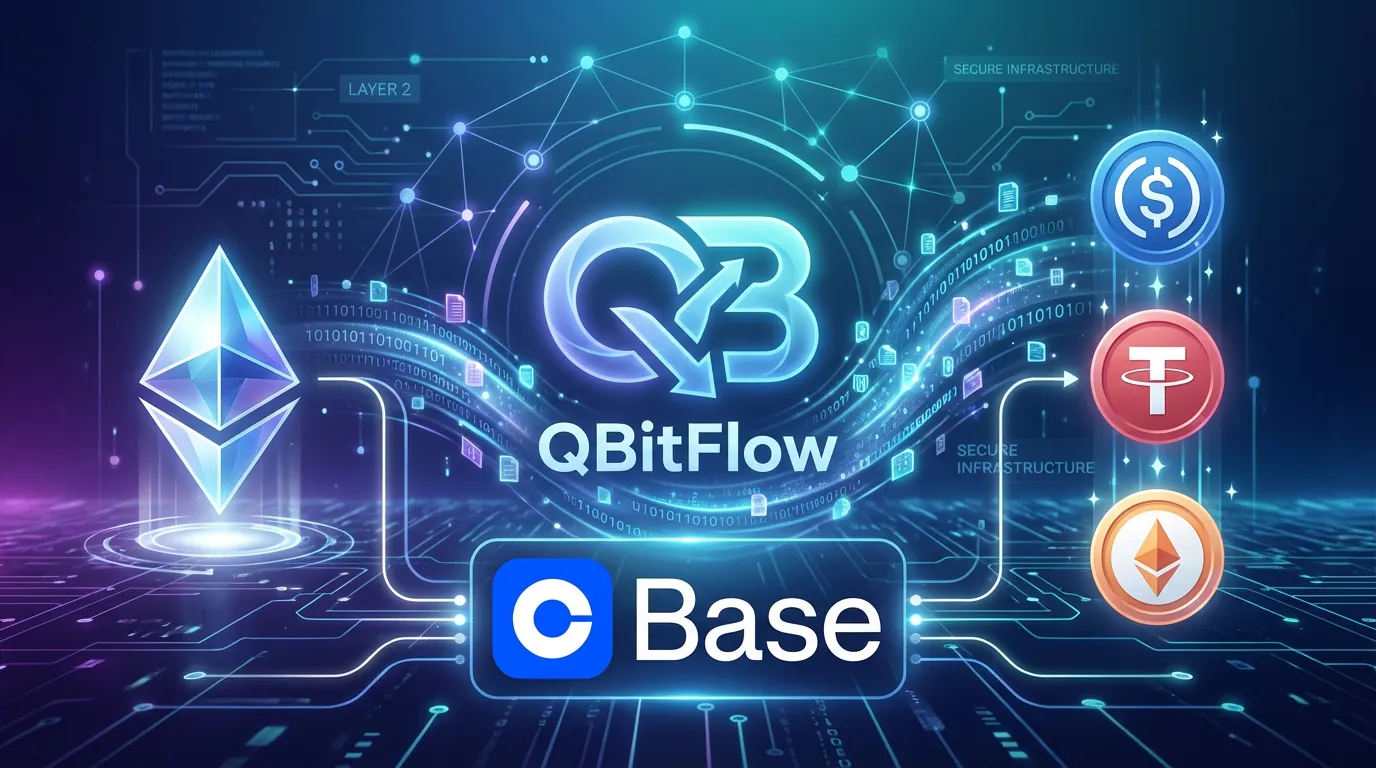
Today we're announcing support for Base, Coinbase's Layer 2 network built on the OP Stack. You can now accept payments on Base alongside Ethereum and Solana.
The short version: same non-custodial model, same API, same fee. But gas costs drop from dollars to fractions of a cent.
Why Base matters for payments
If you've ever processed a crypto payment on Ethereum, you know the pain. A simple USDC transfer can cost $0.50 to $5 in gas fees. For a $10 product, that's a 5-50% surcharge just to move money, before any processing fees.
Base changes the math entirely.
| Ethereum | Base | Difference | |
|---|---|---|---|
| Gas per USDC transfer | $0.50 to $5.00 | $0.001 to $0.01 | ~100x cheaper |
| Block time | ~12 seconds | ~2 seconds | 6x faster |
| Security model | L1 consensus | Settles to Ethereum L1 | Ethereum's trust model |
Base settles to Ethereum while running transactions at a fraction of the cost. For payment processing, this is the sweet spot: you get Ethereum's trust model without Ethereum's gas bills.
What's supported
Tokens on Base include:
- USDC (native): the most widely used stablecoin on Base
- USDT: Tether's stablecoin, bridged to Base
- WETH: wrapped ETH, for ETH-denominated payments (ETH itself works too)
- cbBTC: Coinbase's wrapped Bitcoin, 1:1 BTC-backed. Bitcoin payments on Base without BTC network fees.
- EURC: Circle's euro stablecoin, MiCA-compliant. A native EUR rail for EU merchants.
- DAI: MakerDAO's decentralized USD stablecoin. Crypto-backed, not company-backed.
The docs list every coin supported on each chain.
Payment types:
- One-time payments
- Subscriptions with spending caps (paid in tokens)
Everything that works on Ethereum and Solana now works on Base. Same SDK, same API, same webhooks.
How to accept payments on Base
If you're already using QBitFlow, your code doesn't change. Add a Base wallet in your dashboard and choose the coins it accepts: Base then appears on your hosted checkout. Your customers pick their chain and coin, and the payment goes directly to your wallet.
Python
import os import qbitflow client = qbitflow.That's it. No separate integration for each chain. One API call, and your customers can pay on any chain your wallets accept: Ethereum, Base or Solana.
The cost comparison nobody asked for
Let's run the numbers on a $50 payment (example; gas varies with the network):
| Processor | Merchant fee | Customer gas | Total merchant cost |
|---|---|---|---|
| Stripe | $1.75 (2.9% + $0.30) | none | $1.75 |
| PayPal | $2.24 (3.49% + $0.49) | none | $2.24 |
| BitPay | $1.25 (2% + $0.25) | none | $1.25 |
| QBitFlow (Ethereum) | $0.50 (0.99%) | ~$2.00 | $0.50 |
| QBitFlow (Base) | $0.50 (0.99%) | ~$0.005 | $0.50 |
| QBitFlow (Solana) | $0.50 (0.99%) | ~$0.001 | $0.50 |
With QBitFlow, you pay 0.99% (less as your volume grows), or pass it to your customer at checkout. The network fee is separate: your customer pays it on top, as part of the transaction, just like any on-chain transfer.
On Base and Solana, gas is negligible for your customers too: under a cent per transaction. On Ethereum, gas is higher, which is exactly why L2 support matters.
The result: you pay less than half of what Stripe charges, and nobody can freeze your funds or reverse your payments.
The timing
We won't pretend the timing is a coincidence.
Coinbase shut down Commerce on March 31, 2026. Over 8,000 merchants lost their crypto payment processor overnight. The replacement, Coinbase Business, is custodial and only works in the US and Singapore.
One week later, QBitFlow deploys on Base, Coinbase's own Layer 2.
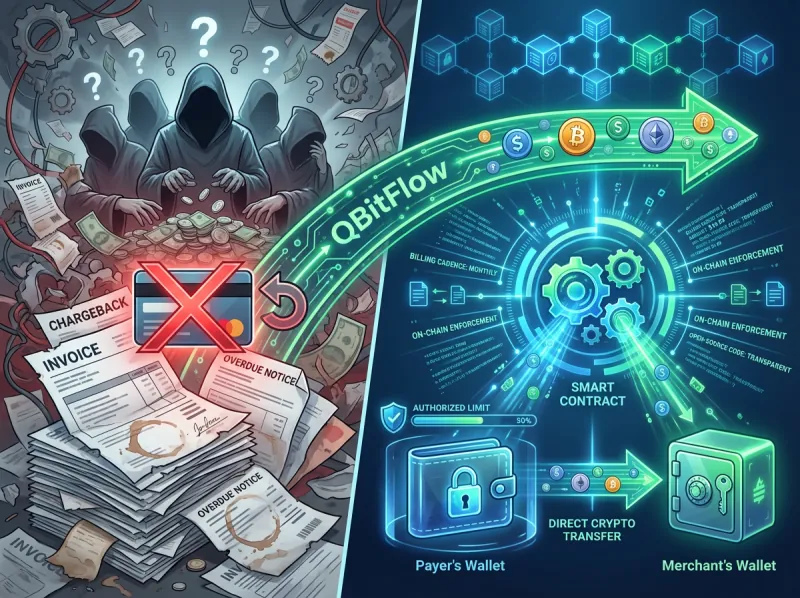
Non-custodial. No seed phrases. Nothing held for anyone to freeze.
If you're one of those 8,000 merchants looking for a new home, we built one. And it runs on the same chain Coinbase built.
Three chains, one philosophy
QBitFlow now supports three chains, each with different strengths:
Ethereum: maximum security and liquidity. Best for high-value transactions where settlement guarantees matter most.
Solana: fast confirmations and the lowest absolute fees. Best for high-frequency, lower-value payments.
Base: Ethereum's trust model at L2 prices. Best for merchants who want the Ethereum ecosystem without the gas costs.
The philosophy stays the same across all three: non-custodial, open-source smart contracts, funds go directly to your wallet. We don't touch your money. We just make it easy for your customers to send it to you.
What's next
Base is our first L2. Which chain comes next depends on what merchants ask for.
For now: if you're building on Base, accepting payments just got a lot simpler.
Get started: qbitflow.app API docs: qbitflow.app/docs/api GitHub: github.com/QBitFlow
QBitFlow is non-custodial crypto payment infrastructure. A 0.99% fee, down to 0.5% with volume. No withdrawal fees. No chargebacks. Ethereum, Base and Solana supported.