
Why Smart Contract Subscriptions Will Replace Traditional Recurring Billing
Subscription billing sounds simple. Charge a customer every month. Send a receipt. Done.
In practice, it's a mess.
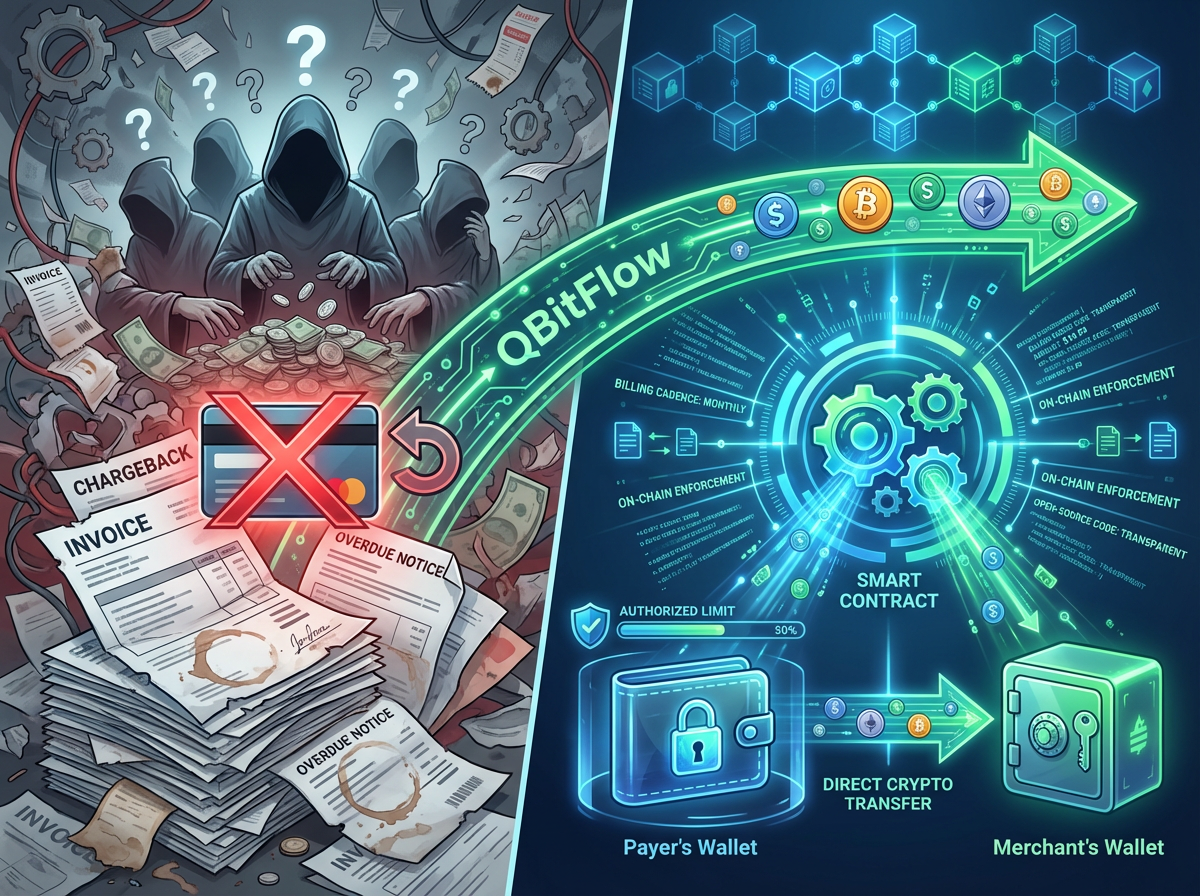
Failed payments cause involuntary churn — the #1 revenue killer for SaaS businesses. Credit cards expire. Banks flag recurring charges as suspicious. Payment processors hold your funds for days. Customers dispute charges they forgot about, and you eat a $15 chargeback fee whether you win or lose.
The entire system runs on trust in intermediaries. Your customer trusts their bank. You trust your payment processor. Everyone hopes the money moves correctly, on time, every time.
Smart contracts eliminate the intermediaries. And with them, most of the problems.
How Traditional Subscription Billing Actually Works
When a customer subscribes to your SaaS through Stripe, here's what happens behind the scenes:
- Customer enters card details → stored by Stripe
- Every billing cycle, Stripe sends a charge request to the customer's bank
- The bank decides whether to approve it
- If approved, Stripe receives the funds and holds them for 2-7 days
- Stripe deposits the funds in your bank account, minus fees
At every step, something can go wrong. The card expires. The bank declines. Stripe flags your account. The customer disputes the charge 60 days later.
You have zero control over any of it. You're a passenger.
How Smart Contract Subscriptions Work
QBitFlow's approach is fundamentally different.
Instead of storing card details with a third party, the customer authorizes a spending cap directly from their crypto wallet. This authorization is a smart contract — code deployed on-chain that defines exactly how much can be charged, how often, and by whom.
Here's the flow:
- Customer connects their wallet and approves a spending cap (e.g., "up to 50 USDC per month")
- The smart contract is deployed on-chain — visible, verifiable, immutable
- Each billing cycle, QBitFlow triggers the contract to pull the authorized amount
- Funds move directly from the customer's wallet to yours. Instantly.
No intermediary holds the funds. No bank decides whether to approve. No 2-7 day settlement wait. No chargebacks — ever.
The smart contract enforces the rules. Not a company. Not a bank. Code.
What This Actually Solves
Failed Payments → Eliminated (Mostly)
Traditional failed payments happen because a bank says no. With smart contracts, there's no bank in the loop. If the customer's wallet has sufficient funds and the spending cap is active, the payment succeeds. Period.
The only failure case: the customer's wallet balance drops below the payment amount. And unlike a declined credit card (where you find out after the fact), you can monitor wallet balances proactively and notify customers before a payment fails.
Chargebacks → Gone
This isn't a marginal improvement. It's a structural elimination.
Blockchain transactions are final. Once confirmed, they cannot be reversed by the customer, their bank, or anyone else. The concept of a chargeback doesn't exist on-chain.
For businesses in high-dispute verticals — digital goods, international SaaS, content subscriptions — this alone changes the economics of the business.
Settlement Delays → Instant
When QBitFlow triggers a subscription payment, the funds arrive in your wallet in the same transaction. Not in 2 days. Not in 7 days. In the same block.
Your cash flow is real-time. You can see exactly what you earned, when, verified on-chain.
Opaque Billing → Fully Transparent
Every subscription authorization, every payment, every cancellation is recorded on the blockchain. Your customers can verify exactly what they authorized and what was charged. You can verify exactly what you received.
QBitFlow's smart contracts are open-source. Anyone can audit the code. This isn't "trust us" transparency — it's "verify it yourself" transparency.
The Spending Cap Model
Most crypto subscription solutions use an escrow model: the customer deposits funds upfront into a contract, and the merchant draws from the escrow. This works, but it's clunky. The customer has to lock up capital. If they want to cancel, they need to withdraw the remaining balance. It feels like a prepaid card, not a subscription.
QBitFlow's spending cap model is different. Funds stay in the customer's wallet until the moment of billing. The smart contract only has permission to pull a specific amount at specific intervals. The customer's capital isn't locked — they can use it for anything else until the billing moment.
Think of it like a credit card authorization, but enforced by code instead of a bank's internal systems.
For the customer: Your money stays yours until you're actually billed. You can see exactly what you authorized. You can revoke the authorization at any time from your wallet.
For the merchant: You get the same predictable recurring revenue, but with instant settlement, no chargebacks, and no dependency on a payment processor's infrastructure.
What About the Customer Experience?
The obvious question: don't customers need crypto wallets? Isn't that a barrier?
Yes — today. But the trajectory is clear.
Wallet adoption is accelerating. Coinbase alone has 110M+ verified users. MetaMask has 30M+ monthly active users. Phantom (Solana) crossed 7M. And these numbers are growing fast as wallets get simpler and more integrated into browsers and mobile devices.
More importantly, you don't have to choose. Run Stripe for card payments and QBitFlow for crypto. Offer both. Let your customers decide. The ones who pay in crypto will cost you less in fees, never chargeback, and settle instantly.
For Web3-native businesses — DeFi tools, NFT platforms, crypto SaaS, DAOs — your customers already have wallets. There's no adoption barrier. QBitFlow is just the obvious infrastructure.
The Technical Details (For Developers)
QBitFlow's subscription smart contracts support:
- Flexible billing periods — weekly, monthly, quarterly, yearly, or custom intervals
- Tiered pricing — upgrade/downgrade plans with prorated adjustments
- Usage-based billing — charge based on on-chain or off-chain usage metrics
- Free trials — automatic conversion to paid with no additional customer action
- Pause/resume — customers can pause without canceling
- Multi-token support — accept USDC, USDT, ETH, SOL, DAI, and more
Integration is straightforward:
The customer clicks the checkout link, connects their wallet, approves the spending cap, and they're subscribed. You get a webhook for every payment event.
Full docs: qbitflow.app/docs
Smart contracts (open-source): github.com/QBitFlow
The Bottom Line
Traditional subscription billing was designed for a world of credit cards and bank transfers. It works, but it's held together by intermediaries, trust assumptions, and manual processes.
Smart contract subscriptions are built for a different world — one where the rules are enforced by code, payments are instant, and neither party needs to trust a middleman.
If you're building a subscription business and your customers have crypto wallets, the question isn't whether to adopt smart contract billing. It's how much you're leaving on the table by not doing it yet.
QBitFlow handles one-time and recurring crypto payments on Ethereum and Solana. Non-custodial, open-source smart contracts, 1.5% flat fee. Start accepting payments →
Related Articles
QBitFlow Now Supports Base: Ethereum Security at L2 Prices
QBitFlow deploys on Base — Coinbase's Layer 2. Accept crypto payments with Ethereum-grade security and gas fees under $0.01. USDC, USDT, EURC, WETH supported.
Read more
Zero Chargebacks, Forever: Why Crypto Payments Eliminate the $40B Chargeback Problem
Visa just tightened chargeback thresholds to 1.5% — merchants above that face $25K/month fines. Chargebacks cost $40B/year globally, and 70% are friendly fraud. Crypto payments eliminate the problem entirely through push-based architecture: no intermediary, no disputes, no reversals. Here's the math on why it saves merchants thousands per month.
Read more