
Zero Chargebacks, Forever: Why Crypto Payments Eliminate the $40B Chargeback Problem
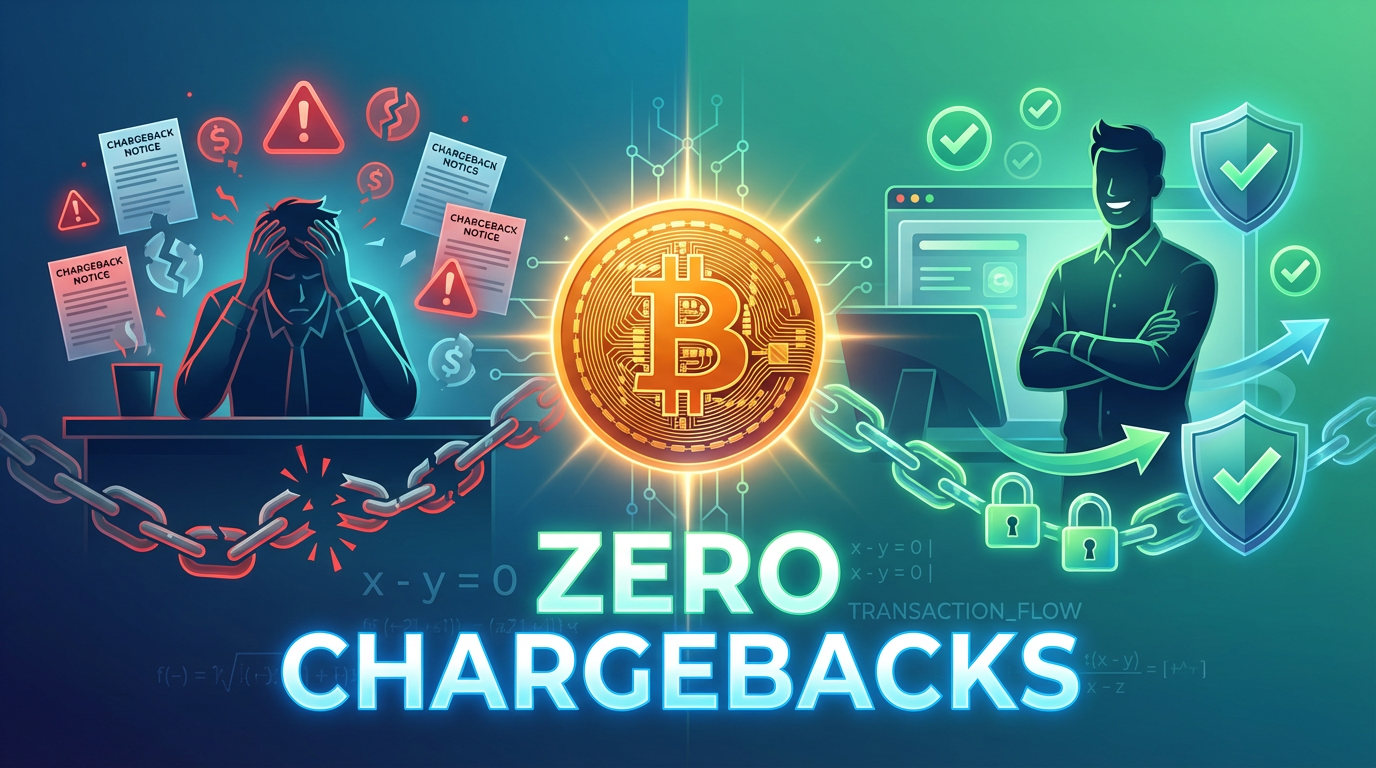
Visa just made it harder to be a merchant.
Starting April 2026, the Visa Acquirer Monitoring Program (VAMP) drops the "Excessive" chargeback threshold from 2.2% to 1.5% across the US, Canada, and the EU. Merchants above that line face fines starting at $25,000 per month, mandatory remediation programs, and potential account termination.
Shopify sellers are already scrambling. Riskified launched a new product called Dispute Resolve specifically for this change. Chargebacks911 is running webinars. An entire industry is mobilizing to help merchants survive a problem that crypto payments don't have.
Not "reduced chargebacks." Not "chargeback protection." Zero. The concept doesn't exist.
Here's why.
The Chargeback Problem in 2026
Chargebacks cost merchants over $40 billion per year globally. That number has grown every year for the past decade.
The mechanics are brutal:
- A customer disputes a charge with their bank
- The bank reverses the payment immediately
- The merchant loses the product, the revenue, AND pays a $15-25 dispute fee
- Even if the merchant wins the dispute (which happens less than 30% of the time), they've spent hours gathering evidence
And here's the part that makes merchants furious: 70% of all card fraud is "friendly fraud." The customer received the product. They just decided to dispute instead of requesting a refund.
Visa's new threshold makes this worse. Previously, you could have a 2.2% dispute rate before getting flagged. Now it's 1.5%. For merchants selling digital goods, subscriptions, or international products — categories with naturally higher dispute rates — this is a ticking clock.
Shopify recently changed its policy so that refunded disputes still count against your chargeback ratio. You can give the money back and still get punished.
Why Chargebacks Exist (And Why They Can't Be Fixed)
Chargebacks aren't a bug. They're a feature of how card networks work.
Credit card payments are "pull-based." You give a merchant your card number. The merchant pulls money from your account. If something goes wrong, the only recourse is to reverse the pull — a chargeback.
This made sense in 1974 when the Fair Credit Billing Act was written. Consumers needed protection from unauthorized charges. But the system was designed for a world where you handed your card to a waiter and hoped for the best.
Fifty years later, the same architecture powers internet commerce. And the 90-day dispute window that protected consumers from shady restaurants now lets anyone reverse any online purchase for almost any reason.
The fraud prevention industry — Riskified, Kount, Sift, Chargebacks911 — exists to patch this design flaw. They're building increasingly sophisticated tools to predict, prevent, and fight disputes. But they're treating symptoms. The underlying architecture guarantees chargebacks will always exist.
You can't fix a pull-based payment system's chargeback problem. You can only manage it.
How Crypto Payments Eliminate Chargebacks
Crypto payments work differently at the architecture level.
Instead of pull-based, they're push-based. The customer sends funds from their wallet. The transaction settles on the blockchain. Done.
There's no intermediary holding the payment. No bank to call. No 90-day window. No dispute process. The smart contract executes, funds transfer, and the transaction is final.
This isn't a policy decision. It's how the technology works. You can't chargeback a blockchain transaction for the same reason you can't un-send cash — once it's transferred, it's transferred.
For merchants, this means:
- 0% chargeback rate. Not low. Zero.
- No dispute fees. The $15-25 per dispute disappears entirely.
- No VAMP monitoring. Visa's thresholds don't apply to transactions that don't go through Visa.
- No friendly fraud. Customers can't reverse a completed crypto payment.
- No evidence gathering. No hours spent compiling shipping receipts and email logs.
"But My Customers Want Refunds"
This is the most common objection. And it's based on a misunderstanding.
Refunds and chargebacks are different things.
A refund is merchant-initiated. The customer asks, the merchant agrees, money goes back. This works fine with crypto payments. The merchant sends funds back to the customer's wallet. Simple.
A chargeback is customer-initiated through a third party (the bank). The merchant has no say. The bank decides.
With crypto payments, merchants keep full control over their refund policy. Want to offer 30-day refunds? Great — you can do that. Want to offer no refunds on digital goods? That's your call, not Visa's.
The difference: the merchant decides when to refund. Not a bank. Not a card network. Not a customer who filed a dispute because they forgot about the purchase.
At QBitFlow, refunds work through smart contracts. The customer creates a refund request, the merchant validates it, the contract executes, and the customer receives funds. Faster than card refunds (which take 5-10 business days) and with zero fees.
The Math: When Crypto Payments Save You Money
Let's run the numbers for a merchant doing $100,000/month in revenue.
Traditional card processing (1% dispute rate):
- Processing fees: $2,900 (2.9%)
- Chargeback fees: $1,500 (100 disputes × $15)
- Lost product value: ~$5,000 (assuming 50% of disputes are on $100 orders)
- Staff time fighting disputes: ~$2,000 (20 hours × $100/hr)
- Total monthly cost: ~$11,400 (11.4% of revenue)
Crypto payments through QBitFlow:
- Processing fees: $1,500 (1.5% flat)
- Chargeback fees: $0
- Lost product value from disputes: $0
- Staff time fighting disputes: $0
- Total monthly cost: $1,500 (1.5% of revenue)
That's $9,900/month in savings. $118,800/year.
Even at a 0.5% dispute rate — half the industry average — the savings are significant. And the operational simplicity of never dealing with disputes is worth something that doesn't show up in a spreadsheet.
The break-even point: if chargebacks cost you more than 1.5% of revenue (including fees, lost product, and staff time), crypto payments are cheaper. For most merchants in high-dispute categories, that threshold was crossed years ago.
The Hybrid Approach
Nobody's saying you should stop accepting credit cards tomorrow. Most customers still pay with cards, and that's fine.
The smart move: add crypto as a payment option alongside cards. Then shift your highest-dispute segments to crypto.
Selling digital downloads? Offer a 5% discount for crypto payments. International subscriptions? Make crypto the default with a card fallback. High-ticket items with frequent "item not as described" disputes? Crypto eliminates the risk.
Over time, as more customers hold stablecoins and crypto wallets become mainstream, the percentage naturally shifts. But you don't have to wait for mass adoption to benefit. Even shifting 10-20% of your volume to crypto meaningfully reduces your overall dispute rate.
Getting Started
QBitFlow is non-custodial crypto payment infrastructure. Here's what that means in practice:
- Funds go directly to your wallet. We never hold your money. Smart contracts handle the transfer.
- 1.5% flat fee. No monthly fees. No withdrawal fees. No hidden costs.
- Setup in under 10 minutes. API integration, hosted checkout, or WooCommerce plugin.
- Ethereum + Solana + Base. 15+ tokens including USDC, USDT, ETH, SOL.
- Subscriptions built in. On-chain spending caps — customers authorize, billing happens automatically.
- Open-source smart contracts. Audit them yourself. Don't trust, verify.
Visa just made chargebacks more expensive. The trend is clear — thresholds will keep tightening, fines will keep growing, and the chargeback prevention industry will keep selling patches for a broken system.
Or you can accept payments on infrastructure where chargebacks don't exist.
Start accepting zero-chargeback payments today → qbitflow.app
Related Articles

Why Smart Contract Subscriptions Will Replace Traditional Recurring Billing
Traditional subscription billing is broken — failed payments, chargebacks, and opaque intermediaries. Smart contracts fix all of it. Here's how.
Read more
QBitFlow Now Supports Base: Ethereum Security at L2 Prices
QBitFlow deploys on Base — Coinbase's Layer 2. Accept crypto payments with Ethereum-grade security and gas fees under $0.01. USDC, USDT, EURC, WETH supported.
Read more