
Why Non-Custodial Matters: The Hidden Risks of Letting Payment Processors Hold Your Crypto

In 2021, OnlyFans nearly banned sexually explicit content — not because they wanted to, but because their banking partners forced their hand. A billion-dollar platform, brought to its knees by payment processors.
In 2022, PayPal froze $6 million belonging to small merchants during a "policy review." Some waited months to get their money back. Some never did.
In 2025, a SaaS founder named Jules lost $6,300 on DodoPayments — a custodial crypto payment processor that fined him after 120 days and kept his funds. He'd already been banned from Stripe before that.
These aren't edge cases. They're the inevitable consequence of a custodial payment model — one where someone else holds your money and decides when (or if) you get it back.
What "Custodial" Actually Means
When you use a custodial payment processor — whether it's Stripe, PayPal, or most crypto payment gateways — here's what happens:
- Your customer pays the processor, not you
- The processor holds the funds in their account
- The processor decides when to release the funds to you
- You hope nothing goes wrong in between
That's the deal. You hand over control of your revenue to a third party and trust them to act in your interest. Most of the time, it works fine. But "most of the time" isn't a risk management strategy.
The Custodial Crypto Trap
Here's what's frustrating: many businesses switch to crypto payments specifically to avoid the problems of traditional processors. But most crypto payment gateways are just as custodial as Stripe.
They accept your customer's crypto, hold it in their wallets, and pay you out on their schedule. The underlying technology changed (blockchain instead of card networks), but the trust model didn't. You're still depending on a company to not freeze, lose, or mismanage your funds.
Some of the most popular crypto payment gateways — Coinbase Commerce, BitPay, CoinsPaid — are custodial. Your crypto goes into their wallets first. You get it when they say so.
The Three Risks You're Taking
1. Account Freezes and Fund Holds
Every custodial processor reserves the right to freeze your account. Read the terms of service — it's always there. They can hold your funds for "review," "compliance," or "suspicious activity," and the definition of those terms is entirely up to them.
Stripe is notorious for this. Search "Stripe froze my account" on any founder forum and you'll find hundreds of stories. Funds locked for weeks or months, with no clear explanation and no human to talk to.
Crypto processors aren't immune. DodoPayments fined a merchant $6,300 after 120 days — money that was already earned, already settled, supposedly already "his." But it wasn't his. It was sitting in DodoPayments' wallet, and they decided to keep it.
The pattern is always the same: your money is in someone else's account, and they have more power over it than you do.
2. Platform Insolvency
When a custodial processor goes bankrupt, your funds go with them. You become an unsecured creditor — last in line, behind employees, secured lenders, and lawyers.
This isn't theoretical. FTX held billions in customer funds. When it collapsed, customers lost everything. Mt. Gox users waited over a decade to recover a fraction of their Bitcoin.
"But those are exchanges, not payment processors," you might say. The risk is identical. Any entity that holds your funds can lose them. The only question is probability — and probability isn't zero.
3. Regulatory and Policy Changes
Custodial processors operate under banking regulations. When regulations change, or when their banking partners get nervous, your business can become collateral damage overnight.
OnlyFans is the textbook example. Their payment processors — Mastercard and the banks behind them — decided that explicit content was too risky. OnlyFans had no choice but to comply. The creators who built their livelihoods on the platform had no say in the matter.
This extends to any industry that traditional finance considers "high-risk": cannabis, supplements, gambling, crypto-related businesses, adult content, firearms. If your business falls into one of these categories, you're one policy change away from losing your payment processing — and any funds the processor is holding.
What Non-Custodial Actually Looks Like
A non-custodial payment processor never holds your funds. Not for a second. Not in escrow. Not in a "settlement account." Not anywhere.
Here's how it works with QBitFlow:
For one-time payments: Your customer pays → funds go directly from their wallet to yours. Done. QBitFlow facilitates the transaction through smart contracts, but the money moves wallet-to-wallet. We never touch it.
For subscriptions: Your customer approves a spending cap via smart contract — say, $50/month. Each billing cycle, the payment executes automatically, sending funds directly from their wallet to yours. The smart contract enforces the rules. QBitFlow never holds, routes, or has access to the funds at any point.
The key difference: there is no moment where your money sits in someone else's account. The blockchain is the settlement layer, and the smart contracts are the rules engine. No intermediary holds your revenue.
"But What If QBitFlow Disappears?"
This is the question that matters — and it's the question that reveals the real difference between custodial and non-custodial.
If a custodial processor disappears, your funds disappear with them. They're in the processor's wallets, and those wallets are gone.
If QBitFlow disappeared tomorrow, nothing would change about your funds. Every payment you've ever received is already in your wallet. The smart contracts that handle subscriptions are deployed on-chain — they're immutable code running on Ethereum and Solana, not on our servers. Active subscriptions would continue to execute even if our website went offline.
This isn't a marketing claim. It's a verifiable architectural fact. The contracts are open-source on GitHub. Anyone can audit them, fork them, or interact with them directly.
The Custodial Spectrum
Not all custodial risk is equal. Here's how different payment models compare:
| Model | Who holds funds | Can freeze your money | Survives platform shutdown |
|---|---|---|---|
| Traditional (Stripe, PayPal) | Processor | Yes | No — funds locked in their system |
| Custodial crypto (BitPay, CoinsPaid) | Processor's wallets | Yes | No — funds in their wallets |
| Semi-custodial (some gateways) | Escrow/smart contract controlled by processor | Technically yes | Depends on implementation |
| Non-custodial (QBitFlow) | Your wallet, always | No — they never have your funds | Yes — contracts run on-chain |
The only model where "can they freeze my money?" is a definitive no is non-custodial. Everything else is a matter of trust — and trust is not a security model.
Real-World Consequences
Let's make this concrete with scenarios that happen every day:
Scenario 1: The Surprise Hold
You're a SaaS doing $30K/month through a custodial crypto gateway. One day, you log in and see: "Account under review. Payouts paused."
No explanation. No timeline. Your $30K in monthly revenue is sitting in their wallet, and you can't touch it. You email support. You get an auto-reply. You wait.
With a non-custodial processor: This scenario is impossible. There's no account to freeze, no payouts to pause. Every payment went directly to your wallet the moment it was made.
Scenario 2: The Policy Change
You sell CBD products online. Your custodial crypto processor sends an email: "Due to updated compliance requirements, we will no longer support CBD-related businesses. You have 30 days to withdraw your funds."
Except the withdrawal process takes 14 business days, and they've already frozen new transactions. You lose two weeks of revenue and spend a month migrating to a new processor.
With a non-custodial processor: A policy change at QBitFlow can't affect your funds because we never had them. You could switch processors tomorrow and not lose a single dollar — everything is already in your wallet.
Scenario 3: The Hack
Your custodial processor gets hacked. Their hot wallets are drained. Your funds — along with thousands of other merchants' funds — are gone.
This has happened to exchanges (Mt. Gox, FTX, Bitfinex). It has happened to DeFi protocols. It will happen to custodial payment processors. The question is when, not if.
With a non-custodial processor: A hack on QBitFlow's infrastructure cannot drain your funds because your funds were never on our infrastructure. They're in your wallet, secured by your keys.
The Objections
"Non-custodial is harder to integrate"
It used to be. It isn't anymore.
QBitFlow offers hosted checkout pages (drop in a link, like Stripe Checkout), APIs with SDKs in Python, Go, and TypeScript, and a no-code dashboard for non-technical merchants. The integration complexity is comparable to Stripe.
You can also customize the hosted checkout to match your brand — your logo, your colors, your copy — while keeping the simplicity of a hosted solution.
"My customers don't have crypto wallets"
Fair point. If your customers are non-technical consumers who only have credit cards, a crypto payment gateway isn't the right primary processor (yet).
But consider:
- 40% of US merchants already accept crypto (PayPal/NCA survey, Jan 2026)
- 93% of freelancers want to be paid in crypto or stablecoins
- 35% of crypto users already receive salary in stablecoins
The wallet gap is closing fast. And you don't have to choose — run Stripe for cards and QBitFlow for crypto. Give your customers the option.
"I trust my current processor"
You probably do. And they probably deserve it — most of the time. But trust is not a substitute for architecture.
You trust your bank too. But you wouldn't keep your entire net worth in a single bank account with no FDIC insurance. You diversify. You hedge. You don't put all your eggs in one basket.
Non-custodial isn't about distrust. It's about eliminating a category of risk entirely. You don't have to worry about whether your processor will freeze your funds if they structurally can't freeze your funds.
The Bottom Line
Every custodial payment processor — traditional or crypto — introduces the same fundamental risk: someone else controls your money. They might be trustworthy. They might have great uptime and responsive support. But they can freeze your funds, and that possibility is a risk you carry every day.
Non-custodial eliminates that risk at the architectural level. Not through promises, not through terms of service, but through code. Your funds go to your wallet. The smart contracts are open-source. There is no intermediary with the power to hold, freeze, or redirect your revenue.
That's what non-custodial means. And that's why it matters.
How QBitFlow Works
- One-time payments: Customer pays → funds go directly to your wallet. Instant.
- Subscriptions: Customer approves a spending cap → automatic billing every cycle → funds go directly to your wallet. No manual steps for you or your customer.
- Fee: 1.5% flat. No hidden costs.
- Chains: Ethereum + Solana. USDC, USDT, and native tokens.
- Contracts: Open-source on GitHub. Verify everything.
Try the full payment flow in test mode (no real funds needed): Get Started →
Your revenue should be in your wallet, not someone else's. Start accepting payments →
Related Articles
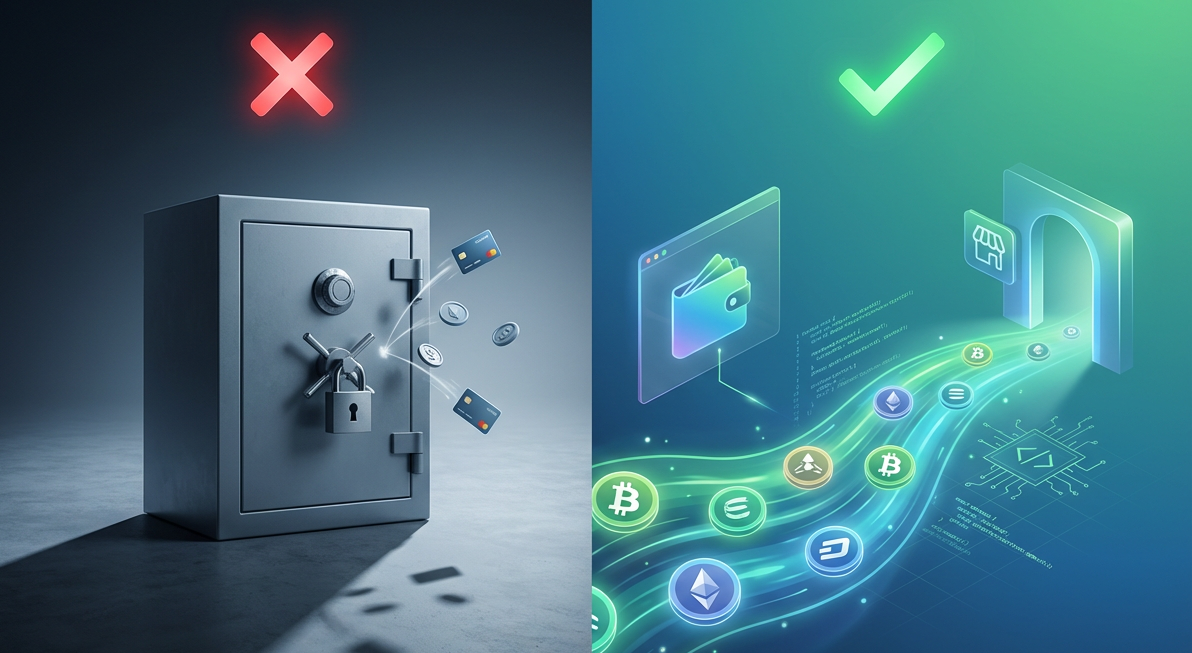
Your Payment Processor Can Freeze Your Money. Ours Can't.
Custodial payment processors hold your revenue, freeze accounts without warning, and add counterparty risk you didn't sign up for. Non-custodial changes everything.
Read more