
How to Accept Stablecoin Payments Without Stripe Approval or KYC
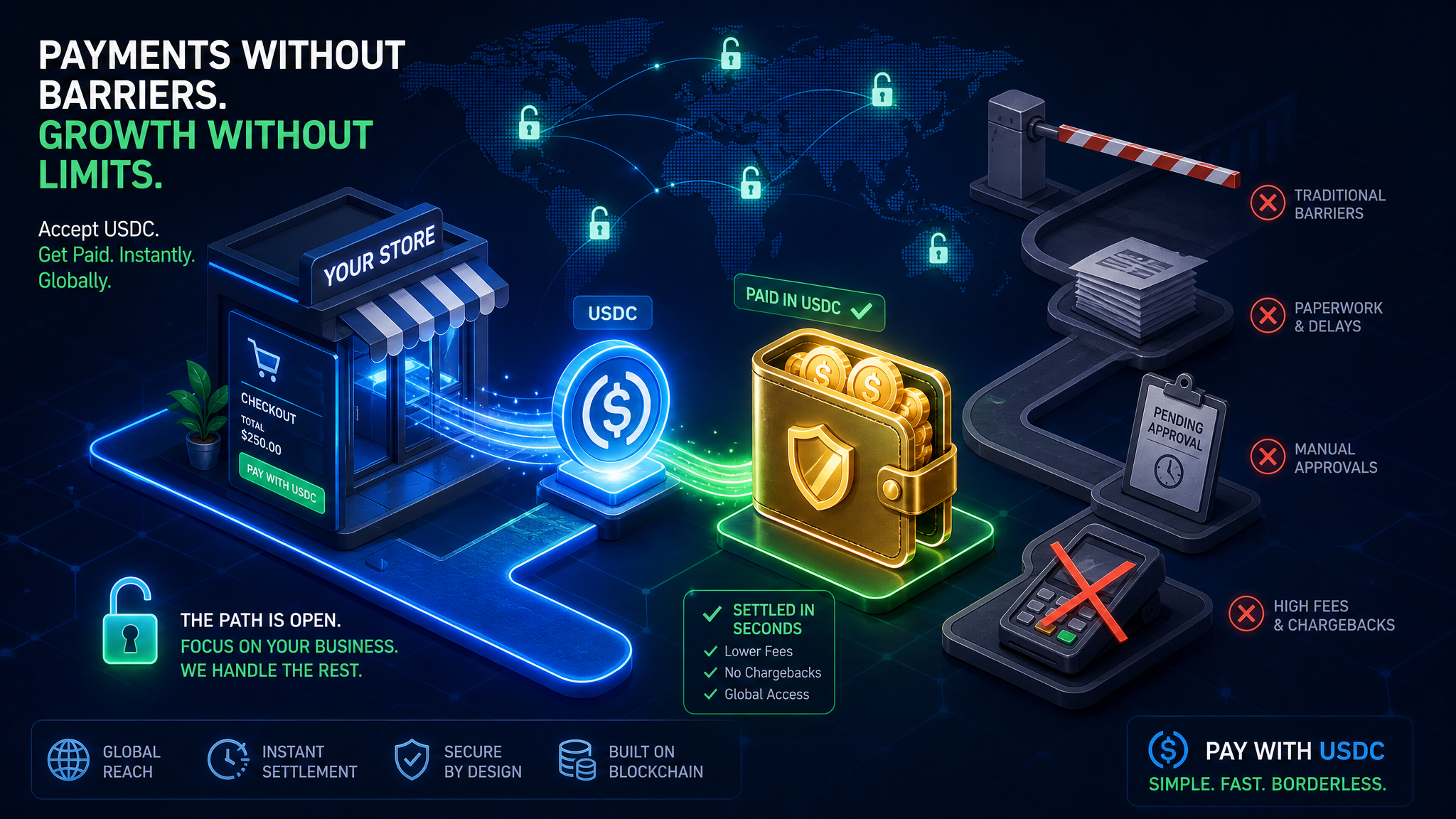
How to Accept Stablecoin Payments Without Stripe Approval or KYC
Getting paid is supposed to be the easy part.
You built something. You found customers. Now you need to collect money — and suddenly you're filling out a 14-field business application, waiting for an approval queue, and hoping your country isn't on a restricted list.
Traditional card processors weren't designed for a global internet. They were designed for the US and EU, for registered businesses with bank accounts, for customers with cards that work everywhere. If you're outside that model — a solo founder in India, an API startup in Brazil, a marketplace builder in Nigeria — you hit walls.
Merchant-of-record services like Paddle and Lemon Squeezy soften some of those walls for software businesses. But they take 5%+, introduce their own approval layer, and you're still waiting for a payout schedule. They also require your customers to pay by card.
Stablecoin payments address a different problem: if your customers already hold stablecoins, you can receive payments directly — no card processor, no custodian, no approval queue.
Why stablecoins, not just any crypto?
Most crypto processors work like this: your customer pays in ETH or BTC, the processor converts it to USD on the backend, and sends you a wire two weeks later. You took on price volatility, you gave up custody, and you waited for a payout anyway.
Stablecoins are different. USDC, USDT, EURC — designed to hold their value against the dollar or euro. Your customer pays in USDC, you receive USDC (minus QBitFlow's 1.5% fee). No conversion, no slippage.
QBitFlow settles in the exact token the customer paid. What goes in is what lands in your wallet — the same denomination, minus the platform fee.
Why QBitFlow specifically?
1. Non-custodial settlement
When your customer pays, the money moves on-chain directly to your wallet. QBitFlow's smart contracts route the payment; QBitFlow never holds the funds. Not for a millisecond. No payout schedule, no minimum balance, no "your funds are available in 3 days."
Your keys — the money is yours the moment the transaction confirms on-chain.
2. No traditional merchant underwriting required to start
Connect a wallet. Create a product. Generate an API key. You're live. QBitFlow doesn't run you through a merchant-underwriting application to get started. You remain responsible for complying with applicable laws and QBitFlow's terms — but you're not waiting for a compliance team to approve your account before you can ship.
That changes the math for a lot of founders.
What you can do today
Everything below is live and working:
One-time payments
A customer pays for something once — a download, an API credit pack, a consulting session. QBitFlow creates a hosted checkout session you link to or redirect into. The customer connects their wallet and pays. The funds go directly to your connected wallet. You get a webhook when the payment confirms.
A 100 USDC payment means 98.5 USDC lands in your wallet. QBitFlow keeps 1.5%. Your customer pays the network gas fee separately.
Recurring subscriptions (token-only)
Subscriptions are token-only — ERC-20 tokens (USDC, USDT, EURC, and others) on Ethereum or Base, SPL tokens on Solana. Native ETH or SOL billing isn't supported.
Your customer signs a spending authorization — a one-time wallet transaction — that sets a cap on what can be billed per cycle. QBitFlow's relayer service then executes billing at your chosen interval: daily, weekly, monthly, yearly, or a custom cadence. The contract's per-subscription allowance is isolated to that subscription's proxy contract, so one subscription's budget can't touch another's. Customers can cancel from a self-managed page and revoke their authorization on-chain.
When a subscription goes past due or cancels, a status-change webhook fires in real time — your backend doesn't need to poll.
Marketplace fee-splitting
If you're running a platform with multiple sellers or creators, QBitFlow splits the payment on-chain at settlement. Your cut goes to your wallet, the seller's cut goes to theirs, at the same time, with no reconciliation step and no holding anyone's funds in the middle.
Getting started: four steps
- Sign up at qbitflow.app/get-started. Email and password. No approval queue.
- Connect your wallet. Browser extension or scan a QR from your phone via Reown/AppKit. No copy-pasting addresses.
- Create a product. Name it, set a price, choose a token and chain.
- Get your API key and integrate. JavaScript, Python, and Go SDKs are documented at qbitflow.app/docs. For one-time payments, one API call creates a checkout session. Test mode runs against testnet — new accounts get test tokens dropped automatically.
Set up a webhook endpoint in your dashboard (Settings → Webhooks) so your backend knows when payments confirm. Payment webhooks fire on terminal statuses: completed, failed, cancelled, expired. Subscription status-change webhooks (active → low on funds, past due, cancelled) are a separate webhook type — configure both in the dashboard.
On security and trust
QBitFlow's smart contracts are open-source on GitHub (https://github.com/QBitFlow) and auditable by anyone.
What this means in practice: you can read every line of code that touches your payments. Every transaction has an on-chain hash verifiable on Etherscan, Solscan, or BaseScan — not a number in a processor's dashboard you have to trust.
The v2 contracts include per-subscription allowance isolation (each subscription gets its own spending proxy — no cross-subscription bleed), and gas refunds that are capped and verified on-chain. If you want to read the contracts before deploying production volume, the source is public and that's exactly what it's there for.
QBitFlow never holds your funds. Custody risk is removed by design.
Good fit / not a good fit
Good fit:
- Stripe rejected you or doesn't serve your market
- Your customers already hold compatible stablecoins in a wallet on Ethereum, Base, or Solana
- You want revenue in your wallet, not sitting in a processor's system
- You're building recurring billing without a card-rails dependency
- You need marketplace fee-splitting on-chain
Not a good fit:
- Your customers pay by card — QBitFlow doesn't provide card acceptance or fiat on-ramps. If your customers don't have compatible wallets and supported tokens, they can't pay you through QBitFlow yet.
- You need a merchant of record to handle tax and invoicing — QBitFlow is payment infrastructure, not a merchant of record. Tax obligations remain yours.
Fees and accounting
QBitFlow charges 1.5% per transaction, flat. A 100 USDC payment means 98.5 USDC lands in your wallet. Customers pay network gas; you keep the rest.
Volume discounts are available for merchants processing $50K+ per month — contact the team separately. Don't count on that number until you're near it.
For accounting, the dashboard exports a CSV of all transactions: 28 columns including token, chain, on-chain hash, USD value captured at time of receipt, and per-transaction fee breakdown. It maps directly to QuickBooks, Xero, or any accounting tool that reads CSV.
Start accepting stablecoins
If your customers hold stablecoins and you want them to reach your wallet directly — without approval queues, without a custodian in the middle, and without a two-week payout schedule — that's what QBitFlow is built for.
Get started — qbitflow.app/get-started
Read the docs — qbitflow.app/docs