
Stablecoin Payments for Marketplaces: How Platforms Can Accept Crypto in 2026.

How platforms can accept crypto in 2026
Marketplaces have always borrowed someone else's payment rails.
Stripe Connect, PayPal for Marketplaces, Adyen for Platforms — every multi-vendor platform you have ever used is, underneath, paying another company to hold its sellers' money for a few days and then forward it on. The model works. It also costs a 0.5% markup on top of card fees, introduces multi-day payout delays, and leaves every platform exposed to the standing risk that the processor decides one category of seller is too risky to serve.
In 2026, that math finally started shifting. Meta began paying creators directly in USDC. Western Union launched USDPT on Solana for cross-border remittances. The EU's MiCA framework opened the door for euro-denominated stablecoin payments at scale. And a generation of marketplace operators started asking the obvious question: if stablecoins move dollars on rails that settle in seconds and cost cents, what are we still paying card processors 3% for?
This post is for the operators asking that question. It covers what changed, where traditional rails break for marketplaces specifically, the three architectures available today, and how on-chain fee splitting closes the gap that custodial gateways have left open.
Why marketplaces are looking at stablecoins in 2026
A few things stacked up in the last twelve months.
Meta's USDC creator payouts (April 2026). Meta started paying Instagram and Threads creators in USDC for select monetization programs, citing faster international payouts and lower friction than the bank-rails system. Whatever you think of Meta, the signal matters: the largest creator platform on Earth concluded that for a meaningful chunk of payouts, stablecoins beat correspondent banking. That moves "creator paid in crypto" from edge case to category.
Western Union's USDPT on Solana. Western Union, the most legacy player in cross-border money movement, launched USDPT (a USD-pegged stablecoin) on Solana. The pitch was the same one crypto people have been making for a decade — faster, cheaper, programmable settlement — except this time it was coming from inside the building.
MiCA in effect. The EU's Markets in Crypto-Assets regulation is fully live, with stablecoin issuers like Circle holding e-money licenses. That gives EU marketplaces a regulated path to accept and pay out in EURC without the regulatory ambiguity that used to kill these projects in compliance review.
Chargeback math for digital goods. Card chargebacks cost online marketplaces an estimated 1-3% of revenue in disputes, fraud, and operational overhead. Stablecoin transactions are final. For digital goods, services, and downloadable content, that eliminates an entire cost center.
Cross-border without correspondent banking. A platform with sellers in 40 countries pays SWIFT fees, FX spreads, and minimum-balance requirements for every corridor. Stablecoins collapse that into one settlement currency and one rail.
The result is that "should we accept crypto" stopped being a 2024-era conversation and became a 2026 product decision.
How traditional marketplace payments work — and where they break
Most marketplaces run on one of two models: Stripe Connect or PayPal for Marketplaces (Adyen for Platforms is similar). Both are custodial. The platform — Stripe, PayPal — holds the seller's funds, takes the card-network fee, takes a platform fee, and pays the seller on a delay.
For a digital marketplace with a 10% platform cut, the typical fee stack looks like this:
- Stripe card processing: ~2.9% + $0.30
- Stripe Connect markup: 0.5% on top
- Platform's own cut: 10%
- Seller take-home: ~86.6%
Then come the operational realities:
Payout delays. Standard Stripe Connect payouts arrive on T+2 to T+7. Instant payouts cost an extra 1.5%. PayPal holds new sellers' funds for up to 21 days. For sellers operating on thin margins, those delays are working-capital expensive.
Account holds and deplatforming. This is the one nobody on the platform side likes to talk about, because the platform is usually the one doing it. When the processor underneath you decides an entire category of seller is too risky, the marketplace inherits that decision. The sellers do not get a vote. Funds in flight can be held; future processing can be cut off entirely. Every marketplace operator I've talked to in the last year has at least one war story.
KYC and dispute overhead. Every seller goes through a custodial onboarding flow that the platform does not control. Disputes get arbitrated by a card network whose incentives do not match the marketplace's.
The custody itself is the root issue. The moment a third party holds the funds between buyer and seller, the marketplace is renting access to its own revenue. Most of the time that rental is fine. The risk shows up at the tail.
The smart-contract alternative
A non-custodial marketplace payment looks structurally different.
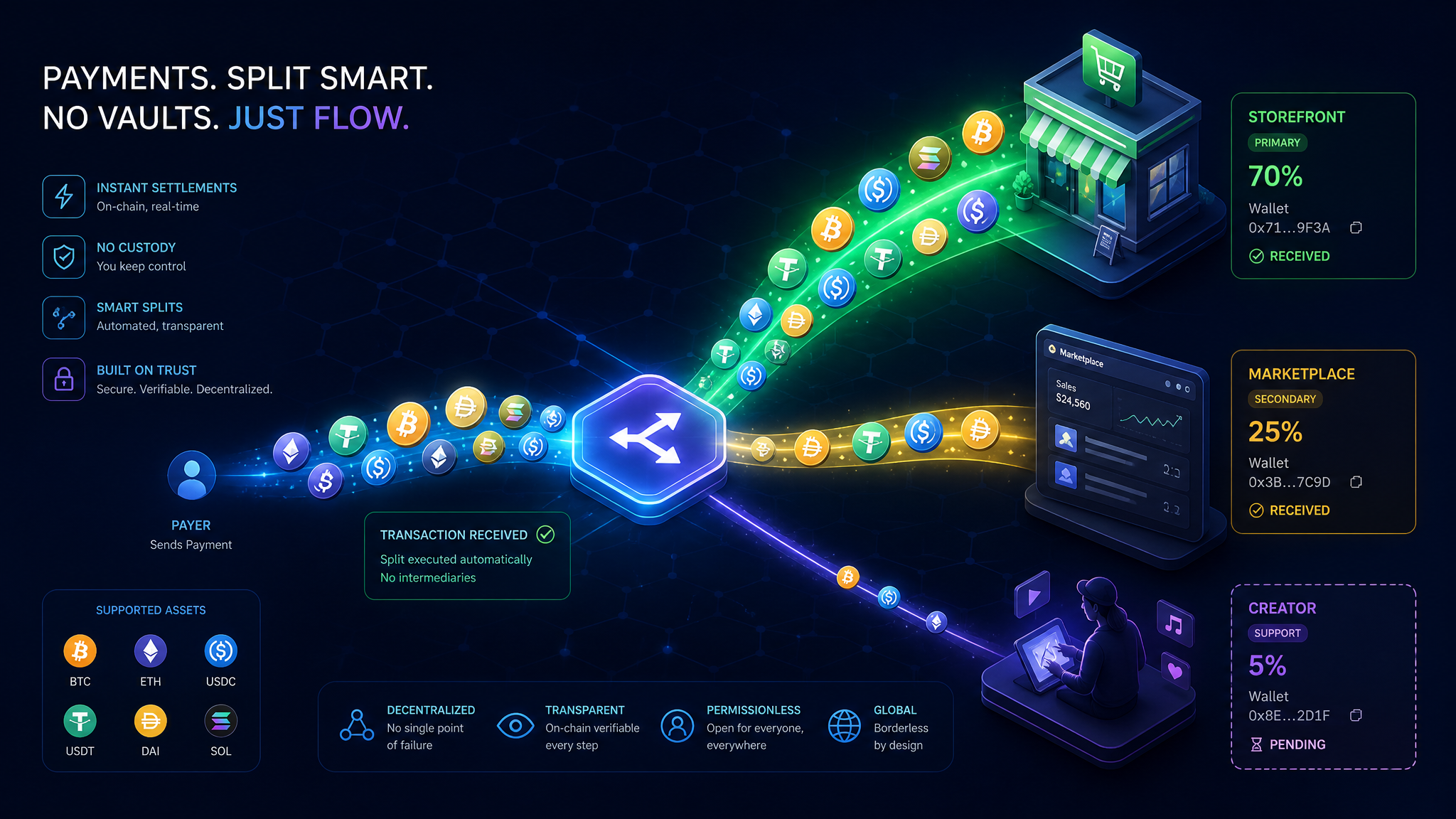
When a buyer pays a seller through a non-custodial gateway, the funds move directly from the buyer's wallet to the seller's wallet via a smart contract. There is no intermediate account. The marketplace's cut — say 10% — is split off on-chain, at the same transaction, into the platform's own wallet. The remaining 90% lands in the seller's wallet immediately. Settlement is one transaction, one block, both parties paid.
A few properties fall out of this:
- No payout delay. The seller has the funds the moment the buyer signs. No T+2, no instant-payout surcharge, no rolling reserve.
- No omnibus account. No third party holds the funds at any point. The platform cannot freeze a seller's revenue, because the platform never holds it. Neither does the gateway.
- Automatic fee enforcement. The platform's cut is encoded in the smart contract. There is no monthly reconciliation, no manual invoicing, no risk that a seller forgets to remit.
- Auditable rules. Open-source contracts mean both the platform and the seller can read the exact logic that governs every payment. The contract is the agreement.
This is what QBitFlow ships today. The marketplace creates an organization account, adds user-level accounts for its sellers, sets a fee percentage per user, and the smart contracts handle the rest. Every payment that flows through a seller's hosted checkout splits at settlement: platform takes its cut on-chain, seller receives the remainder in the exact token the customer paid with. No auto-swap, no slippage, no conversion fee.
Supported chains today are Ethereum, Solana, and Base, with full token coverage for the stablecoins marketplaces actually want — USDC, USDT, EURC, and DAI across all three. The contracts are on GitHub at github.com/QBitFlow.
Three models for marketplace stablecoin payments
If you are a marketplace operator looking at stablecoin payments seriously in 2026, you have three real options. Each has a place; the right one depends on what you optimize for.
Model 1: Custodial crypto gateways (BitPay, Coinbase Commerce, MoonPay for Business)
A custodial gateway is structurally Stripe-shaped. The gateway holds the funds, takes a fee, and pays out to the seller on a schedule. The customer pays in crypto; the merchant typically receives a payout in the chosen currency.
Pros: familiar operational model, integrations look like existing payment-processor integrations, the gateway absorbs some of the complexity.
Cons: every issue with the custodial model carries over — deplatforming risk, payout delays, account holds, opaque dispute handling. You have replaced the card network with a crypto company that can still freeze your sellers' funds. The architecture has not actually changed.
Best for: marketplaces that want a crypto on-ramp but are not ready to rethink the custody model.
Model 2: Self-hosted, self-custody (BTCPay Server)
Open-source, self-hosted, fully non-custodial. The marketplace runs its own infrastructure, accepts crypto directly, and handles fee splitting in application code.
Pros: maximum control, zero fees to a third-party gateway, no platform risk.
Cons: you are now running payment infrastructure as a side product. Hosting, uptime, key management, smart-contract development (if you want on-chain fee splits), chain support, wallet compatibility — all on you. For a marketplace whose core product is not payments, this is a lot of surface area to own.
Best for: technically deep teams who want to own every piece of the stack and have the engineering bandwidth to maintain it.
Model 3: Non-custodial gateway with smart-contract fee splits (QBitFlow)
This is the model the rest of this post has been describing. A managed service that ships the integration layer — hosted checkout, SDKs, dashboard, webhooks — but settles non-custodially via open-source smart contracts. Fees split on-chain at the transaction. The gateway never holds funds.
Pros: non-custodial settlement (no deplatforming risk, no payout delays, no held funds), but you do not run the infrastructure. Smart-contract fee splits work out of the box — no application-layer reconciliation. The platform gets ten-minute setup time, the seller gets immediate settlement.
Cons: still a managed dependency. If the gateway disappears tomorrow, the smart contracts keep running (they're open-source and on-chain), but the dashboard, hosted checkout, and SDK maintenance go with it. This is a real consideration; it is also why the contracts being open-source matters.
Best for: marketplaces that want non-custodial settlement without becoming a payments company.
The honest version: model 1 is fine if you just want a crypto button. Model 2 is right if payments are core to your product. Model 3 is the middle path — and it is the one most marketplace operators end up at once they have run the numbers.
Setting up marketplace payments with QBitFlow
The integration path for a marketplace looks roughly like this. Numbers below are accurate as of May 2026; check qbitflow.app/docs for the current state.
-
Create an organization account. Sign up at qbitflow.app/get-started with email and password. Connect a public wallet address — Ethereum, Solana, or Base. The wallet receives the platform's fee splits; QBitFlow never sees a private key.
-
Add user-level accounts for sellers. Each seller on your marketplace gets a user account inside your org. Two options here:
- Already-onboarded sellers connect their own wallet at signup. Their share of every payment routes directly to that wallet.
- New sellers without a wallet start as unclaimed accounts. Payments to them route to your org wallet, with an off-chain ledger tracking what's owed to whom and an on-chain transaction hash captured for every payment. When the seller is ready, they go through a claim flow (set password, connect wallet, you sign one transaction to release everything they have earned). After that, it's standard non-custodial settlement.
One caveat worth flagging upfront: subscriptions don't work on unclaimed accounts (subscriptions hash the recipient wallet at creation, so the wallet has to exist first). One-time payments work fine for unclaimed users.
-
Configure your fee percentage per user. Smart contracts enforce it. There is no manual reconciliation, no monthly remittance — your cut lands in your wallet at the same block as the seller's cut.
-
Integrate via SDK or REST API. Customers always pay through QBitFlow's hosted checkout — the SDK and the API are just the tools your backend uses to manage customers, products, and create checkout sessions. Each session returns a checkout URL you redirect the customer to. The hosted page handles wallet connection, chain selection, and payment confirmation, and ships with theme + logo customization plus custom success/cancel redirect URLs. QBitFlow ships SDKs for JavaScript/TypeScript, Python, and Go at feature parity if you want a typed client; if your stack isn't covered, hit the REST API directly.
-
Wire up webhooks for your backend. Per-payment webhooks fire on terminal status only —
completed,failed,cancelled,expired. Signature verification uses HMAC headers (X-Webhook-Signature-256 + X-Webhook-Timestamp), and the SDKs expose client.webhooks.verify() to handle the check.
Typical time from signup to first live payment is around ten minutes. New merchants get automatic testnet faucet funds at account creation, so the full sandbox flow runs before you touch real money.
For platforms running WordPress, the WooCommerce plugin is available on GitHub today at WooCommerce Plugin — install it directly from there and it works end-to-end. The plugin has also been submitted to the official WordPress plugin directory and is currently under review, so one-click install from the WordPress store is coming soon. A standalone WordPress plugin (for sites not running WooCommerce) is in active development.
Who should consider this
Not every marketplace needs to accept crypto. The model fits some categories better than others.
Creator platforms — content subscriptions, digital goods, paid newsletters, fan platforms. Digital goods are the cleanest fit: no chargebacks matter most where physical fulfillment is not in the dispute path, and creators have been the most vocal about wanting cross-border payouts.
Freelancer marketplaces — design, dev, writing, consulting. International freelancers have been routing around correspondent banking with crypto for years; formalizing that flow with smart-contract escrow and instant settlement is the obvious upgrade.
Multi-vendor e-commerce — especially platforms with international sellers or sellers in categories where card processors are inconsistent.
Gaming asset marketplaces — in-game items, digital collectibles, NFT secondary markets. Stablecoin settlement with on-chain fee splits is already the dominant model here; the question is which gateway, not whether.
SaaS platforms with revenue sharing — anyone embedding payments in a product where part of the revenue routes to a third party (template marketplaces, plugin stores, API resellers).
If you are running one of these and your current payment stack costs you more than 1.5% in gateway fees, has ever held a seller's funds longer than you wanted, or has a category-risk story you would rather not repeat — the math is worth running.
FAQ
What currencies and tokens are supported? Ethereum mainnet (ETH, WETH, USDC, EURC, USDT, LINK, WBTC, DAI), Solana (SOL, WSOL, USDC, USDT, EURC, LINK, DAI), and Base (ETH, WETH, USDC, USDT, EURC, DAI, cbBTC, AERO). For marketplaces, USDC and USDT cover the vast majority of real volume.
How do sellers receive funds? Directly to their wallet, in the same token the buyer paid with. No auto-swap, no conversion. If a buyer pays in USDC on Base, the seller receives USDC on Base. The marketplace's fee split also lands in the same token, in the same transaction.
What are the fees? 1.5% flat, paid by the merchant out of the payment. No separate billing, no withdrawal fees, no chargeback fees. Customer pays gas. Volume discounts kick in at $50K+/month. The platform's own marketplace cut is on top of that 1.5%, and it lands in the platform's wallet on-chain.
Is this compliant with regulations? Stablecoin payment infrastructure under MiCA, EMT/ART rules in the EU, and the relevant US frameworks is workable today — the issuers (Circle, Tether, etc.) hold the licenses; the gateway is settlement infrastructure. As always: talk to your own counsel about your specific jurisdiction and customer mix before going live.
What if QBitFlow disappears tomorrow? The smart contracts are open-source and live on-chain. Settlement keeps working. You would lose the hosted dashboard, the SDKs, and the support, but the funds and the contract logic are not in QBitFlow's custody at any point — that's the point of non-custodial.
If you are running a marketplace and want to talk through how on-chain fee splitting would fit your stack, the QBitFlow checkout takes about ten minutes to set up and the docs at qbitflow.app/docs cover the full marketplace integration. We'd rather show you the contracts than the slide deck.
Related Articles
Crypto Payments for Marketplaces: Splitting Fees On-Chain Without Holding Anyone's Money
How marketplaces, platforms, and creator networks can take a cut of every transaction automatically — on-chain, non-custodial — and pay vendors who don't even have a wallet yet.
Read more